


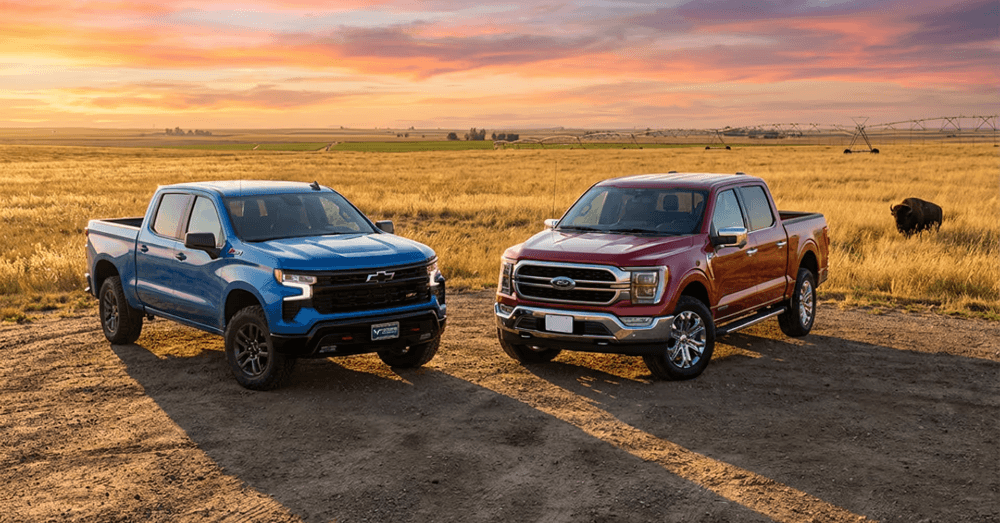
The full-size truck fight isn’t slowing down, and the 2026 model year proves it. Chevy’s refreshed Silverado 1500 and Ford’s updated F-150 keep trading punches on power, towing, and tech, leaving buyers with two very capable options and a few meaningful differences worth knowing before signing anything.
- Both trucks top out near 13,300 to 13,500 pounds of max towing, but they get there with very different engine lineups.
- Ford leans on turbocharged V6s and a hybrid, while Chevy still offers a 5.3L and 6.2L V8 alongside a smooth inline-six diesel.
- Interior tech, ride comfort, and trim strategy separate them more than raw spec sheets suggest.
Powertrains: Two Very Different Philosophies
The 2026 Silverado 1500 sticks with a familiar quartet. There’s the 2.7L Turbo-Max four-cylinder rated at 310 horsepower and 430 lb-ft, the 5.3L V8 with 355 horsepower, the 6.2L V8 pushing 420 horsepower and 460 lb-ft, and the standout 3.0L Duramax inline-six diesel making 305 horsepower and a stout 495 lb-ft of torque. Chevy buyers can still walk into a showroom and pick a real V8, which matters to a lot of longtime owners.
Ford takes a different route. The 2026 F-150 carries the 2.7L EcoBoost V6, the 5.0L Coyote V8, the 3.5L EcoBoost V6, and the 3.5L PowerBoost hybrid that pairs the twin-turbo V6 with an electric motor for 430 horsepower and 570 lb-ft. The hybrid also adds Pro Power Onboard, giving owners up to 7.2 kilowatts of jobsite or campsite electricity. If you want the most torque in a half-ton without going diesel, Ford has it.
Towing, Payload, and Daily Capability
On paper, the trucks are nearly even. A properly equipped F-150 with the 3.5L EcoBoost can tow up to about 13,500 pounds. The Silverado 1500 with the 6.2L V8 and Max Trailering Package lands around 13,300 pounds. Payload favors Ford in most configurations, with select F-150s rated above 2,400 pounds. Chevy counters with one of the easier tailgates to live with thanks to the Multi-Flex design, and the available bed-view camera system makes hitching a trailer almost too simple.
Real-world towing is where the diesel Silverado earns its fans. The Duramax delivers strong low-end pull and 20-plus mpg highway when unloaded, something no gas V8 in this class can match. The PowerBoost hybrid F-150 shines in stop-and-go traffic and on long commutes between job sites.
Interior, Tech, and Ride Quality
Chevy’s recent cabin overhaul finally puts the Silverado on par with its rivals. Higher trims get a 13.4-inch touchscreen, a 12.3-inch digital cluster, and Google built-in. Ford answers with its 12-inch SYNC 4 display, the clever interior work surface in the center console, and Max Recline seats that actually let you sleep on a long haul.
Ride quality goes to Ford in most trims thanks to its smoother independent setup tuning, though Chevy’s optional adaptive dampers on higher trims close the gap. If you’re cross-shopping family haulers and considering something smaller like a GMC Terrain for daily driving duty, the Silverado’s quieter cabin and softer ride at higher trims feel like a natural step up without losing that car-like comfort.
Off-Road, Trims, and Pricing Reality
Off-road buyers get spoiled. Chevy offers the ZR2 and ZR2 Bison with Multimatic DSSV dampers, front and rear lockers, and 33-inch tires. Ford counters with the Tremor, Raptor, and the supercharged 5.2L Raptor R that throws down 720 horsepower for buyers who want a desert weapon more than a work truck.
Pricing for 2026 starts in the low $40,000s for both trucks in basic crew-cab form, climbing well past $80,000 once you load up a High Country, King Ranch, Platinum, or Raptor. Ford generally has more trims to slice the market, while Chevy keeps its lineup a little tighter and easier to shop.
Picking the Right Truck for Your Driveway
If you want a V8 soundtrack, a smooth diesel option, and a quieter cabin, the 2026 Silverado 1500 makes a strong case. If you value the hybrid’s jobsite power, more trim choices, and a slightly higher payload, the F-150 stays tough to beat. Test drive both on roads you actually use, with the trailer or gear you actually haul. That’s the only spec sheet that really counts.
