


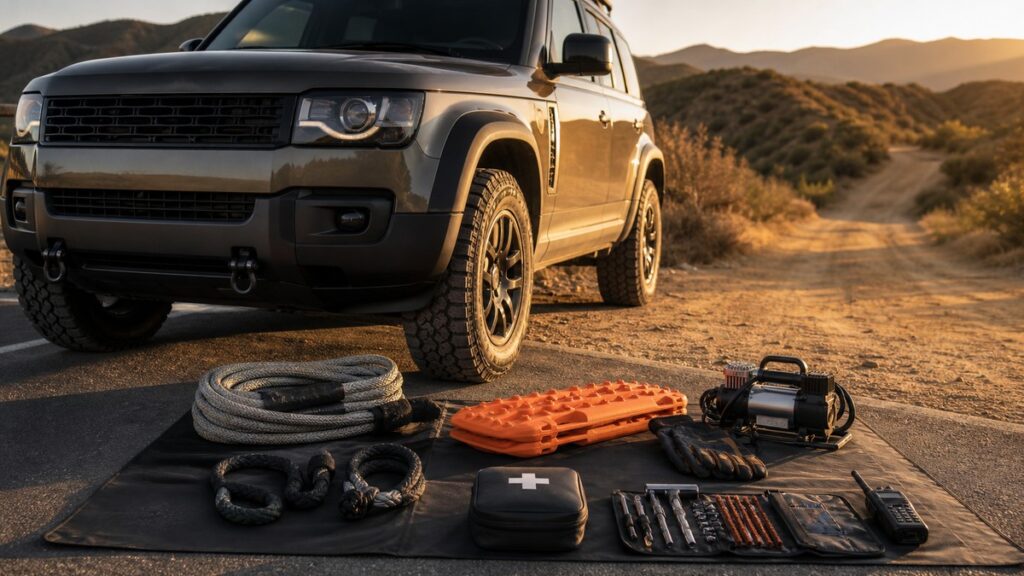
Getting stuck is almost a rite of passage once you point your rig toward remote trails, and the right kit turns a stressful afternoon into a quick fix. Mud, sand, snow, and steep, loose climbs can all stop a capable truck cold. What matters is not how many gadgets you own but whether you have the few tools that actually free a vehicle, plus the knowledge to use them without getting hurt.
- Rated recovery points and quality straps come first, since everything else hangs off them
- Traction boards, air management, and a repair plan solve most self-recovery situations
- Safe rigging habits like line dampeners and standoff distance keep a broken part from becoming a projectile
Start With Rated Recovery Points
Before you buy a single strap, figure out where you can safely attach one. Manufacturer-rated recovery points are the only spots designed to absorb the forces involved in a pull. Never hook to a tow ball, a bumper bracket, or a random loop that looks strong enough. Those parts can tear loose and fly.
Your strap should match the vehicle it needs to move. A good rule is a breaking strength two to three times your rig’s gross weight. If your truck has a curb weight around 5,000 pounds, look for a recovery strap rated near 12,500 pounds or higher. Pair it with shackles you trust. D-shackles are the classic metal choice, while soft shackles made from synthetic line are lighter, gentler on gear, and safer if something lets go. Inspect anything braided regularly, since synthetic gear depends on clean, undamaged fibers.
Traction Tools That Get You Moving
Recovery boards are the simplest way to earn back grip in soft stuff. Dig out the front of each tire with a shovel, wedge the boards close to the wheels at a slight angle, then feed in gentle throttle and let the tires bite. Spinning them only digs you deeper. Pick a bright color too. A neutral board might match your paint, but a hi-vis one is far easier to find in a mud hole or on a beach.
A full-length shovel earns its space. Short folding models tuck away nicely, yet they make you work twice as hard when a tire is buried. If you often travel alone, a winch changes the math. Rig it to a solid anchor with a tree-saver strap, reel in slowly under steady tension, and watch the line for stress. Synthetic winch line costs a little more but stays lighter and safer than steel when you maintain it.
Air Management and a Tire Repair Plan
Airing down is free traction. Dropping pressure spreads the tire’s footprint so it floats on sand or mud instead of plowing through. Aim for roughly 50 to 65 percent of your highway pressure in soft terrain, and around 65 to 75 percent to smooth out rough, washboard roads. Do not drop below 10 to 15 PSI, since the bead can unseat. Lower pressure means softer steering, so slow down to match.
But there’s a catch. You must be able to put that air back. Carry a compressor and a pressure gauge, because driving on low tires at speed wears them fast and handles poorly. Toss in a plug kit as well. A single sidewall-safe puncture repair can be the difference between limping to help and waiting for it.
Communication and First Aid You Can Reach
Cell coverage disappears fast once you leave town. A backup way to signal for help, whether a two-way radio, a satellite messenger, or a personal locator beacon, keeps a stuck vehicle from becoming a stranded person. Tell someone your route and expected return before you go.
Keep a stocked first aid kit within arm’s reach, not buried under gear. Recovery work happens around heavy loads and pinch points, so add thick gloves, eye protection, and sturdy boots. Those handle the scrapes and cuts that come with digging, rigging, and hauling.
Rig It Safe, Every Single Time
The most valuable habit is patience. Walk through each pull before you start. Check your angles, confirm your points are rated, and picture what happens if a link fails. Drape a line dampener, a winch blanket, or even a heavy bag over the middle of any loaded line. If something snaps, that weight drops the line instead of letting a hook rocket toward a windshield.
Clear every bystander well outside the danger zone, and keep hands away from a strap under tension. Snatch straps and kinetic ropes are consumables. Inspect them for wear, let them cool between hard pulls, and retire them when the fibers look tired. Practice these moves on easy ground so they feel automatic when the terrain gets ugly. The gear only works as well as the person running it.
