
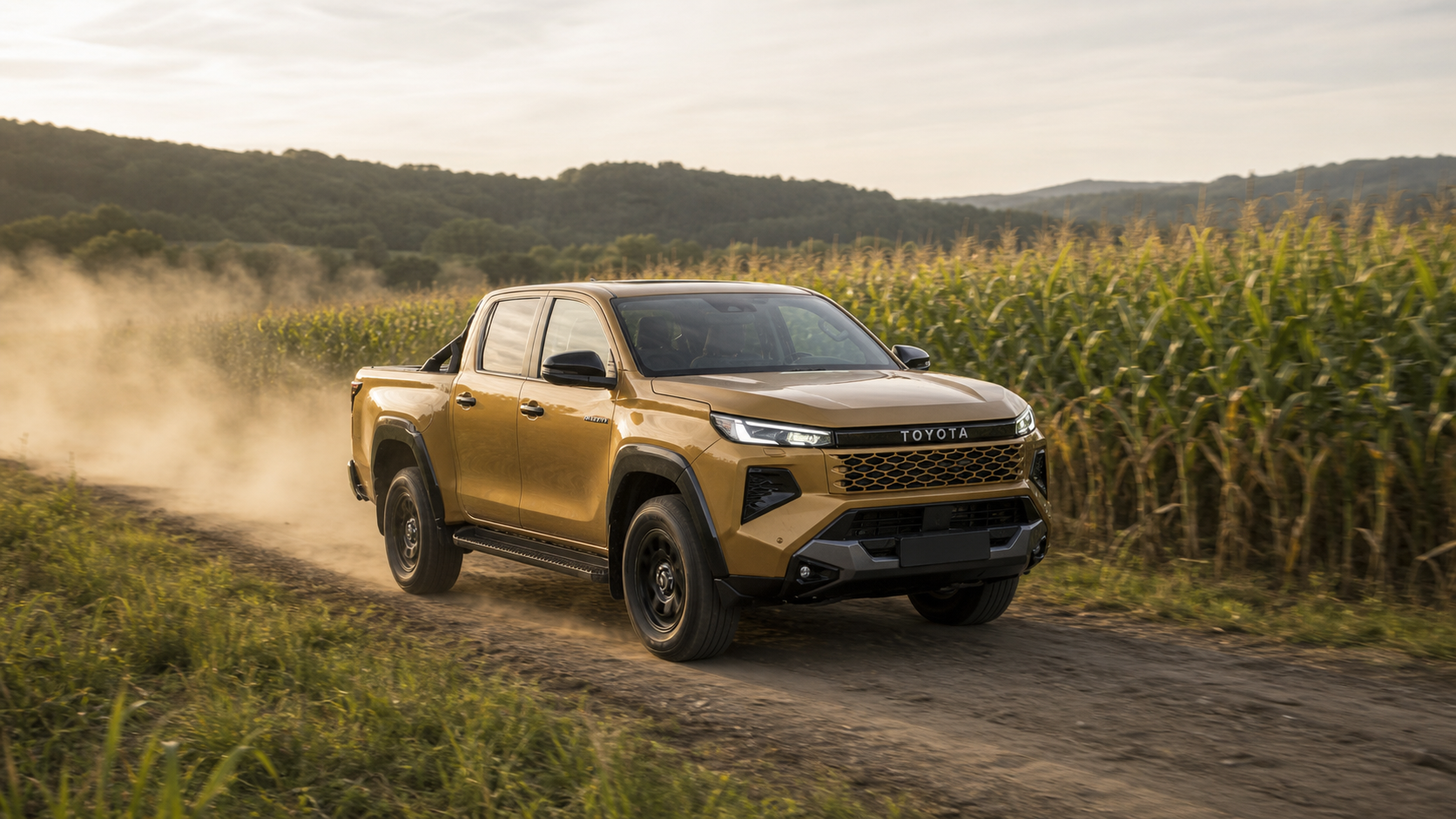
The Hilux has spent more than five decades hauling loads, crossing bad ground, and clocking in for work across more than 190 countries and regions since its 1968 debut. The ninth generation leaves that job description alone. What changes is almost everything around it, from the sheet metal to the dashboard to the list of powertrains you can order.
- The ladder-frame structure stays, and the diesel model keeps part-time four-wheel drive.
- The Double Cab interior is all new, with available 12.3-inch screens and physical 4WD controls you can find without looking.
- Choices now run from diesel to a 48V mild hybrid to a battery-electric version in some markets.
Same Bones, Very Different Sheet Metal
The new Toyota Hilux exterior follows a design theme it calls Tough x Agile, with the Japan-market version described under a Cyber SUMO concept. In plain terms, the truck looks squarer and more deliberate than before. Slim headlights sit at the outer edges of a broad grille, and TOYOTA lettering spans the front instead of a badge. The bumper and fender treatment is angular, which gives the truck a planted stance without a lot of fussy detail.
One of the smarter additions doesn’t involve styling at all. Toyota added steps into the rear deck area, so climbing into the bed no longer means hauling yourself over the tailgate or hunting for a foothold on the bumper. The separate cargo deck stays, which matters to anyone who beats up a truck bed for a living and wants that section to stay independent from the cab.
A Cabin With Land Cruiser Influence
The Double Cab interior is where the generational jump shows most. Toyota drew on the current Land Cruiser for the layout, and depending on grade and market you get a 12.3-inch center multimedia display paired with a 12.3-inch digital driver display. Screens that size in a pickup used to feel like a luxury item. Here they read as ordinary equipment for a truck that spends as much time on highways as it does on job sites.
Toyota kept the four-wheel-drive controls physical and grouped them in the center of the dash rather than burying them in a menu. That’s a small decision with real consequences when you’re in gloves, in mud, or in a hurry. Electric power steering is part of the update too, along with connected services on applicable grades.
Specs That Change With the Map
Numbers vary by market, so it pays to be specific. The Japan-market truck measures 5,325 mm long, 1,885 mm wide, and 1,865 mm high, and carries up to 500 kg. The European Hybrid 48V version comes in at 5,320 mm long, 1,855 to 1,885 mm wide, and 1,865 mm high, riding on a 3,085 mm wheelbase.
For that European Hybrid 48V setup, Toyota lists a 2.8-liter diesel producing 204 DIN hp and 500 Nm. It can carry more than 1,000 kg, tow up to 3,500 kg, and wade through 700 mm of water. Those figures belong to that configuration and shouldn’t be read as a blanket promise across every Hilux on sale. The broader point is that Toyota’s multipath approach now puts diesel, mild hybrid, and fully electric versions under one nameplate, with availability set market by market.
Safety and Off-Road Tech Catch Up
Toyota Safety Sense functions expand on the new truck, with blind-spot monitoring and upgraded camera coverage available depending on grade and region. Off-road, Multi-Terrain Select and Multi-Terrain Monitor show up on certain grades, giving drivers surface-specific settings and a clearer view of what’s under and around the truck when the trail gets tight.
Toyota also points to better steering feel and a more settled ride, helped along by the switch to electric power steering. That’s the part fleet drivers tend to notice after month three, not on the test drive.
Why This Hilux Still Reads as a Work Truck
Toyota didn’t chase a lifestyle rebrand here. The frame, the part-time 4WD on the diesel, the separate cargo deck, and the towing and payload focus all say the same thing about who this truck is built for. What’s new is the stuff that used to be an afterthought in a pickup, like screen real estate, driver assistance, steering feel, and simply getting into the bed without a struggle. If you’re shopping trucks that need to earn their keep, the ninth-generation Hilux is worth watching as it rolls out market by market, since the spec sheet you get will depend heavily on where you sign the paperwork.
This article might include affiliate links, which means we may receive a commission if you make a purchase using these links, without any additional cost to you. We have thoroughly researched and tested all products featured to provide a trustworthy review.