
Pickup trucks own roughly 30% of all new vehicle sales in the United States. That’s a massive slice of the market, and Volkswagen is tired of watching from the sidelines. At the 2026 New York International Auto Show, VW’s top executive in the U.S. made it clear that a Volkswagen truck could actually happen, even though nothing is official yet.
- Volkswagen Group of America’s CEO said he “wouldn’t rule out” the idea of a pickup at the 2026 New York Auto Show.
- VW is looking at two truck segments: a traditional midsize truck competing with the Tacoma and Colorado, or a unibody compact pickup like the Ford Maverick and Hyundai Santa Cruz.
- Volkswagen hasn’t sold a pickup truck in the US since the Rabbit Pickup left production in 1984.
VW’s American CEO Opens the Door
Dr. Kjell Gruner, CEO of Volkswagen Group of America, told media at a panel during the 2026 New York International Auto Show that the brand can’t “rule out” the idea of a pickup, though he said a few things need to line up before the brand can actually build one for the American market. Gruner noted that doing business in the States means keeping an eye on the entire market, especially for pickup trucks, which account for about 30% of all new vehicle sales.
Gruner called out B- and C-segment pickups by name, which are typically unibody and could use VW Group’s existing MQB architecture. Volkswagen has its own modular vehicle platform, which the brand uses to build everything from small hatchbacks to full-size SUVs, hybrids, and EVs, and these vehicles all share one trait: unibody construction. That makes a compact or midsize unibody truck a natural fit for VW’s existing engineering setup.
Two Truck Paths VW Could Take
If VW does pull the trigger, they’re reportedly looking at two truck classifications: a true midsize competitor or a smaller, unibody compact pickup.
The midsize route already has a running start. If Volkswagen decides to take the fight directly to the Chevrolet Colorado and Toyota Tacoma, they already have the Amarok sitting in their global arsenal, and the current-generation model shares a large amount of architecture with the Ford Ranger thanks to the commercial and EV partnership between the two companies. The Amarok’s turbocharged 2.3-liter inline-four makes 300 horsepower and 333 pound-feet of torque, slightly more than the 270 hp and 310 lb-ft that the same engine produces in the American Ranger. So if VW adapted that truck for U.S. roads, it would show up with a factory power advantage over its closest platform sibling.
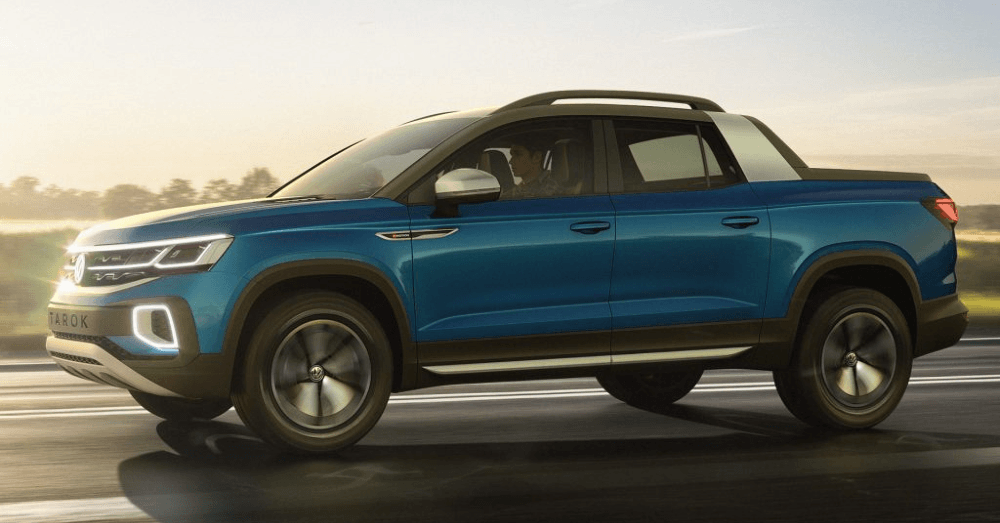
On the compact side, things are less clear. Something based on the recently revealed 2027 Atlas could work, since that platform can already tow 5,000 pounds, matching the similarly constructed Honda Ridgeline. Volkswagen has also shown off concepts in this space before, including the Atlas Tanoak concept in 2018 and the Tarok concept, which previewed a smaller unibody approach. VW also plans to produce the Tukan for the South American market starting next year.
Obstacles Standing in the Way
Due to the Chicken Tax law in the US, VW hasn’t been able to offer a truck without building it locally. That 25% tariff on imported light trucks has been a barrier for decades, and it’s one of the reasons the Amarok has never crossed the Atlantic. If buyers are currently hunting for lease deals on midsize trucks, they’re choosing from a limited field of established players like Toyota, Ford, and Chevrolet. Adding a Volkswagen badge to that mix would require either a domestic assembly line or a creative workaround.
When asked whether a new pickup would be unibody or body-on-frame, Gruner said “both can be successful” and that it depends on the intended use. A body-on-frame truck lends itself to off-road and rugged applications, while a unibody could use existing VW platforms and be designed for on-road comfort. That flexibility sounds nice on paper, but it also means VW hasn’t settled on a direction yet.
Don’t count on VW of America making any formal announcements about its pickup future any time soon. Gruner said that the company is always evaluating new possibilities, including lifestyle or commercial-oriented vans and trucks.
A Bigger Commercial Push?
The truck talk tied into a broader conversation about VW’s commercial ambitions in America. Gruner said the automaker was also considering bringing some of its commercial vehicles to America, a move that would put VW in direct competition with the Mercedes-Benz Sprinter. The Volkswagen Type 2, known as the Bus or Transporter, is one of the most famous examples of American van culture, which is dominated today by Mercedes. A VW cargo van plus a pickup truck would be a serious expansion of the brand’s American presence.
Should Truck Shoppers Pay Attention?
There’s no VW truck in the immediate pipeline, and Gruner was careful to say that no official decisions have been made. But VW isn’t starting from zero. They have a proven midsize truck platform that already shares DNA with the Ford Ranger. They have concept history showing they’ve explored both compact and midsize truck designs. And they have a CEO who, for the first time in a long time, isn’t shutting the door on the idea. For truck fans who’ve been waiting since the Rabbit Pickup days, that’s the closest thing to a green light VW has given in over 40 years.
This article might include affiliate links, which means we may receive a commission if you make a purchase using these links, without any additional cost to you. We have thoroughly researched and tested all products featured to provide a trustworthy review.
 Lucas Foster